Showing posts with label News. Show all posts
Showing posts with label News. Show all posts
12/4/08
Makin' it big
The article on GameCraft finally made it's way to a website on the 2nd. Check it out here


11/21/08
Chris is a Winner!
As a side-note to GameCraft, I managed to presage my winning the raffle. I got a copy of Steven Spielberg's Wii title Boom Blox which is a lot of fun, unless you don't have a Wii to play it on, in which case it's only mildly fun to have sitting on the counter.


GameCraft has a winner!
Austin, Texas: State capital, indie music mecca, and home to a few no-name development companies like, oh, Bioware, Midway, Retro Studios, NCSoft, Sony Online Entertainment, and Red Fly. It's also the host of the annual Austin Game Developers Conference, SXSW, and where Richard Garriot rests his head. Last night, tucked away in the University of Texas campus, the Electronic Game Developers Society (EGaDS) held the their annual design competition “GameCraft”.
“[We're] mostly made up of students who want to work in the game design industry” Joseph Harding, president of EgaDS, tells me. “[Our group] serves as an educational networking resource for these students. UT does not have a game development program, so we fill that role. As our members do often go on to work in the game design industry, we keep in contact with them and try to maintain an industry-student relationship.” I asked Harding about any notable EGaDS alumni: “Currently working in the industry, that I know of, we have Gary Bland (now at Vigil Games), Alan Comely (now at Pixel Mine), and Ryan Beberwyck (on leave from Sony Online) as well as the founder of EGaDS, Michael Agustin, who now owns his own game company, Gendai Games.”
GameCraft challenges design teams to create a professional pitch for a game of their own creation. While a working version of the game isn't required to compete, the plot, visuals, gameplay mechanics, and production costs all must be accounted for and delivered in a neat and effective package – the way a developer would pitch to a potential publisher. After a grueling question and answer session from the judges, the top two presentations are awarded first and second place and given their pick from a group of top PC titles.
Industry veteran and Executive Producer at Red Fly Studios, Mike McSchaffry gave contestants some final advice at the preliminaries on November 6th. His top elements of a perfect pitch: originality, preparation, conciseness, and lots of art. “This is a visual industry” he explained, encouraging participants to show, rather than tell publishers about their game. He ended by reminding aspiring developers not to be nervous – big publishers like EA need people with ideas just as much as people with ideas need funding.
EA, NCSoft, and SOE have all been GameCraft sponsors in the past, with SOE attending this semester, providing prizes, food, and free goodies like t-shirts and posters. “We've had a lot of [notable] people come to EgaDS,” says Harding, “I really enjoyed having Suan O'Connor, local writer from Gears of War and Bioshock, come and speak because her field, dedicated writing, is normally under-represented in game design.”
After raffles, food, and introductions, the contest began. Four teams and four games came up to bat: “Time Marauder”, “Haunt”, “Arm of the Inquisitor”, and “Blind Faith”. The five judges, Julianna Budding, an EGaDS alumni and Designer at SOE; Jared Carr, Art Director at SOE; Oge Young, Producer at SOE; Steve Jackson, founder of Steve Jackson Games; and Kalani Streicher, the founder of Kalani Games Inc., represented the various disciplines that come together when creating a game. After all the teams had presented, the judges gave some final advice to all aspiring developers.
First, Steve Jackson asked contestants to justify the time that goes into coding a part of a game with the amount of time the player will spend actually using and exploring that content. Unless it is integral to gameplay, a mini-game, which might sound great on paper, may not warrant the time and money it would take to code. Programmers, like all the members of a development team, are a resource that must be used wisely.
Passion, something all the contestants showed, was a big plus in the judges' eyes. Games often take years to complete, and a developer's passion serves as a crucial anchor point for the entire team. “It's the ones you really care about that you're more likely to finish” said Jackson.
Jared Carr shared an exercise that he has used in pitching games, which helps to tighten the concept. After you've formulated a basic idea, ask your team to design the box for that game. This includes the front cover-art, title, back cover-art, and the text that appears on the back of the box. Designing the box yields several advantages: it instantly expresses the game's tone and visual style, it helps the developer to see if their game stands out against competitors, and it forces the team to boil the game's unique features down to three or four bullet points.
All of the judges echoed this need for uniqueness, with two good reasons in mind: it sets your game apart from the competition, giving buyers a reason to choose it over a hundred other games, and it gives publishers a reason to hire you and your ideas, rather than make the game themselves. The judges stressed how crucial it was to put your development team into the picture when pitching a game. If your idea, for example, is to combine the gameplay from Gears of War with the visuals from Team Fortress 2 and the plot from Wall-E, it must be clear to the publisher why they need you to create that specific game and not simply switch Gears of War for Unreal Tournament and make it themselves. Some concepts, however, are unique enough to justify the development team, like Narbacular Drop.
Lastly, Oge Young praised the elevator pitch as a crucial element of any presentation. The formula – This meets That, but with this other thing – instantly establishes common ground in explaining a concept. He added one last warning when employing it “...for god's sake, use a good game to compare yours to....” Sorry, no Haze meets Imagine: Babyz with Beverly Hills Chihuahua.
After the contest was over, aspiring developers had the opportunity to rub shoulders with the judges and learn more about getting into the industry.
To me, GameCraft represents the growing popularity of videogame development as a career. Gone are the days of developing in parents' basements, in obscurity and shame. Any doubts about videogames as a serious business have been obliterated by Nintendo's juggernaut gaming-for-everyone campaign. No one can ignore the billion dollar industry that is still going strong, not even the Texas Governor Rick Perry, who spoke at E3.
“The gaming industry portrays a work ethic, business model and embrace of new ideas that our nation would be wise to consider.... I congratulate this growing industry on its success, and invite further expansion in Texas where the barbecue is hot and the video gaming is even hotter.”
It's a wonder that, in a city as involved in the industry as Austin, the university has yet to offer a degree in game development or design; but it's only a matter of time before the rest of the country catches up with popular culture.
“[We're] mostly made up of students who want to work in the game design industry” Joseph Harding, president of EgaDS, tells me. “[Our group] serves as an educational networking resource for these students. UT does not have a game development program, so we fill that role. As our members do often go on to work in the game design industry, we keep in contact with them and try to maintain an industry-student relationship.” I asked Harding about any notable EGaDS alumni: “Currently working in the industry, that I know of, we have Gary Bland (now at Vigil Games), Alan Comely (now at Pixel Mine), and Ryan Beberwyck (on leave from Sony Online) as well as the founder of EGaDS, Michael Agustin, who now owns his own game company, Gendai Games.”
GameCraft challenges design teams to create a professional pitch for a game of their own creation. While a working version of the game isn't required to compete, the plot, visuals, gameplay mechanics, and production costs all must be accounted for and delivered in a neat and effective package – the way a developer would pitch to a potential publisher. After a grueling question and answer session from the judges, the top two presentations are awarded first and second place and given their pick from a group of top PC titles.
Industry veteran and Executive Producer at Red Fly Studios, Mike McSchaffry gave contestants some final advice at the preliminaries on November 6th. His top elements of a perfect pitch: originality, preparation, conciseness, and lots of art. “This is a visual industry” he explained, encouraging participants to show, rather than tell publishers about their game. He ended by reminding aspiring developers not to be nervous – big publishers like EA need people with ideas just as much as people with ideas need funding.
EA, NCSoft, and SOE have all been GameCraft sponsors in the past, with SOE attending this semester, providing prizes, food, and free goodies like t-shirts and posters. “We've had a lot of [notable] people come to EgaDS,” says Harding, “I really enjoyed having Suan O'Connor, local writer from Gears of War and Bioshock, come and speak because her field, dedicated writing, is normally under-represented in game design.”
After raffles, food, and introductions, the contest began. Four teams and four games came up to bat: “Time Marauder”, “Haunt”, “Arm of the Inquisitor”, and “Blind Faith”. The five judges, Julianna Budding, an EGaDS alumni and Designer at SOE; Jared Carr, Art Director at SOE; Oge Young, Producer at SOE; Steve Jackson, founder of Steve Jackson Games; and Kalani Streicher, the founder of Kalani Games Inc., represented the various disciplines that come together when creating a game. After all the teams had presented, the judges gave some final advice to all aspiring developers.
First, Steve Jackson asked contestants to justify the time that goes into coding a part of a game with the amount of time the player will spend actually using and exploring that content. Unless it is integral to gameplay, a mini-game, which might sound great on paper, may not warrant the time and money it would take to code. Programmers, like all the members of a development team, are a resource that must be used wisely.
Passion, something all the contestants showed, was a big plus in the judges' eyes. Games often take years to complete, and a developer's passion serves as a crucial anchor point for the entire team. “It's the ones you really care about that you're more likely to finish” said Jackson.
Jared Carr shared an exercise that he has used in pitching games, which helps to tighten the concept. After you've formulated a basic idea, ask your team to design the box for that game. This includes the front cover-art, title, back cover-art, and the text that appears on the back of the box. Designing the box yields several advantages: it instantly expresses the game's tone and visual style, it helps the developer to see if their game stands out against competitors, and it forces the team to boil the game's unique features down to three or four bullet points.
All of the judges echoed this need for uniqueness, with two good reasons in mind: it sets your game apart from the competition, giving buyers a reason to choose it over a hundred other games, and it gives publishers a reason to hire you and your ideas, rather than make the game themselves. The judges stressed how crucial it was to put your development team into the picture when pitching a game. If your idea, for example, is to combine the gameplay from Gears of War with the visuals from Team Fortress 2 and the plot from Wall-E, it must be clear to the publisher why they need you to create that specific game and not simply switch Gears of War for Unreal Tournament and make it themselves. Some concepts, however, are unique enough to justify the development team, like Narbacular Drop.
Lastly, Oge Young praised the elevator pitch as a crucial element of any presentation. The formula – This meets That, but with this other thing – instantly establishes common ground in explaining a concept. He added one last warning when employing it “...for god's sake, use a good game to compare yours to....” Sorry, no Haze meets Imagine: Babyz with Beverly Hills Chihuahua.
After the contest was over, aspiring developers had the opportunity to rub shoulders with the judges and learn more about getting into the industry.
To me, GameCraft represents the growing popularity of videogame development as a career. Gone are the days of developing in parents' basements, in obscurity and shame. Any doubts about videogames as a serious business have been obliterated by Nintendo's juggernaut gaming-for-everyone campaign. No one can ignore the billion dollar industry that is still going strong, not even the Texas Governor Rick Perry, who spoke at E3.
“The gaming industry portrays a work ethic, business model and embrace of new ideas that our nation would be wise to consider.... I congratulate this growing industry on its success, and invite further expansion in Texas where the barbecue is hot and the video gaming is even hotter.”
It's a wonder that, in a city as involved in the industry as Austin, the university has yet to offer a degree in game development or design; but it's only a matter of time before the rest of the country catches up with popular culture.
11/10/08
GameCraft Preliminaries in Austin

Austin, Texas: State capital, indie music mecca, and home to a few no-name development companies like, oh, Bioware, Midway, Retro Studios, NCSoft, and Red Fly. It's also the host of the annual Austin Game Developers Conference, SXSW, and where Richard Garriot rests his head. This past Thursday, tucked away in the University of Texas campus, the Electronic Game Developers Society (EGaDS) held the preliminaries for their annual game design competition “GameCraft”.
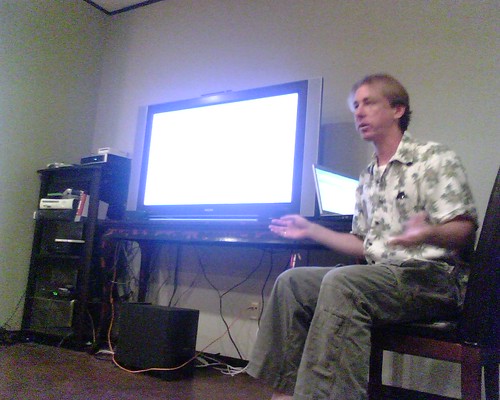
The contest challenges design teams to come up with a professional pitch for a game of their own creation. Plot, visuals, gameplay mechanics, production costs, all must be accounted for and delivered in a neat and appealing package, just the way a developer would pitch to a potential publisher. GameCraft also gives companies a chance to scout out future employees.
Industry veteran and now Executive Producer (read: “head ass-kicker”) at Red Fly studios, Mike McShaffry (http://www.mcshaffry.com/mrmike/) was on-hand to give contestants advice on how to pitch to publishers. His top elements of a perfect pitch: originality, preparation, conciseness, and lots of art. “This is a visual industry” he said, encouraging participants to show, rather than tell publishers about their game. Mr. Mike ended by reminding aspiring developers not to be nervous – big publishers like EA need people with ideas just as much as people with ideas need funding.
Stay tuned for the GameCraft finals taking place on November 20th. If you're in the Austin area, don't miss out on the chance to score some free schwag, talk to developers, and see some cool games.
10/24/08
Break out the champagne
My first news post went up yesterday. A small step, but it's in the right direction.
Here's the link:
http://ps3.thegamereviews.com/story-2204-PSN-October-23rd-Update.html
Here's the link:
http://ps3.thegamereviews.com/story-2204-PSN-October-23rd-Update.html
9/30/08
A month to remember
October 2008 is a good time to be a gamer. I don't know if you've realized this but there are more triple-A titles coming out between October 14th and 24th than you could hope to get through in a year. What games are they, you ask? Try Rock Band 2, Midnight Club: Los Angeles, BioShock (for us Sonyites), Far Cry 2, Little Big Planet, Spider-Man: Web of Shadows, Guitar Hero World Tour, Fallout 3, MotorStorm: Pacific Rift, Dead Space, and Fable II. The hype for these titles has been snowballing for years, most notably in the case of Little Big Planet and Fable II.
The former promises to revolutionize the way we perceive gameplay by putting the game's creation tools into our hands from the outset. Media Molecule seems to be saying: forget about how you think the game should be played, instead make the game whatever you want it to be. Heck, even turn the process of making the game into the game iself! Their focus on user-created content is backed by an extensive online community where players can share the levels they have created and leave feedback on the levels they've played. This online portion of the game opens up a world of possibilities including contests, internet fame, and all kinds of socialization.
Fable II has had its share of hype as well, although Peter Molyneux's hopeless enthusiasm for his own games may be to blame. He has promised that Fable will grip your emotions by the proverbial balls and leave you a weeping husk should your beloved dog or child die. Yes, even your asshole friend can kill them in co-op, and no, you'll never see them again. Though always visionary on paper, we'll have to wait and see if Lionhead Studios' latest title really manages to tug on the ol' heartstrings.
The former promises to revolutionize the way we perceive gameplay by putting the game's creation tools into our hands from the outset. Media Molecule seems to be saying: forget about how you think the game should be played, instead make the game whatever you want it to be. Heck, even turn the process of making the game into the game iself! Their focus on user-created content is backed by an extensive online community where players can share the levels they have created and leave feedback on the levels they've played. This online portion of the game opens up a world of possibilities including contests, internet fame, and all kinds of socialization.
Fable II has had its share of hype as well, although Peter Molyneux's hopeless enthusiasm for his own games may be to blame. He has promised that Fable will grip your emotions by the proverbial balls and leave you a weeping husk should your beloved dog or child die. Yes, even your asshole friend can kill them in co-op, and no, you'll never see them again. Though always visionary on paper, we'll have to wait and see if Lionhead Studios' latest title really manages to tug on the ol' heartstrings.
Subscribe to:
Posts (Atom)


